
TPM #362: When Does Ignoring Established Developmental Guidelines Become Negligent?
Could youth sport organizations be liable when athletes suffer because of programming decisions that ignore developmental models ?

Matt Young recently penned a thoughtful essay on the lie being exacerbated by sport organizations and leaders spouting one thing and doing another.
Year-round programs continue to flourish despite evidence supporting contrary programming.
Younger generations are being introduced to increasing levels of physical, emotional and psychological load, long before they are equipped to manage it.
Burnout rates are rising, overuse injuries are normalized and anxiety and identity pressure are showing up at younger ages.
More children are walking away from sport because the environment surrounding it has become overwhelming.
Modern day sport is no longer being driven by development. It is being driven by fear and revenue
The entire system has drifted into an arms race where everybody feels pressured to offer more because they believe that if they don’t, someone else will. And in that process, the athlete absorbs the consequences.
Human development is not linear and neither is athletic progression. Stress + Recovery = Adaptation. Yet, youth sport has eliminated recovery and therefore safe adaptation from the equation.
The irony is that many of the qualities we claim to value most in athletes; creativity, resilience, adaptability, confidence, decision-making and intrinsic motivation are often developed most effectively in the exact environments we have systematically removed: unstructured play, free movement, peer interaction and self-directed exploration. The off-season isn’t a luxury, it is a developmental necessity.
Imagine if clubs committed to protecting two or three months of the year for decompression and regeneration.
Actual recovery, freedom and space. At minimum, this could mean reducing structure and encouraging informal activity. At its best, it could mean intentionally creating environments that reintroduce children to movement without pressure. Equipment left out at parks, open gym access, pickup games, mixed-age activities and community spaces where kids can simply play again.
Parents and youth sport leaders, we are influencing whether they view physical activity as a lifelong source of joy or as a system of pressure they cannot wait to escape.
The most progressive organizations of the future may not be the ones offering the most programming, they may be the ones disciplined enough to create boundaries around it.
And if we already know that excessive volume, chronic pressure and insufficient recovery introduce meaningful harm to children, then the next look ourselves in the mirror question is:
At what point does knowingly ignoring that reality become negligence?
Here is the full post from Matt Young
Every National Sport Organization in Canada signs off on long-term athlete development principles. The research and frameworks exist and the funding structures are tied to LTAD alignment.
Across the country, organizations publicly acknowledge the importance of age-and-stage development, recovery, multi-sport participation, mental health, physical literacy and appropriate competition volumes.
The words ‘periodization’ and ‘development’ have become interchangeable language on brochures everywhere.
And yet, despite all of this, many of the same systems continue to support, directly or indirectly, a year-round model of sport participation that contradicts nearly every principle they claim to believe in. More games, camps, showcases, identification events, training, travel and pressure to “keep up.”
The result is a generation of young people being introduced to increasing levels of physical, emotional and psychological load, long before they are equipped to manage it.
Burnout rates are rising, overuse injuries are normalized and anxiety and identity pressure are showing up at younger ages. More children are walking away from sport because the environment surrounding it has become overwhelming. At some point, we have to stop lying that we do not see what’s happening, or it’s not us.
Because that’s exactly what we’re doing. Lying.
Many youth athletes are still participating in schedules that mirror, and surpass professional sport schedules.
Seasons now stretch across ten or eleven months of the year.
Some young athletes participate in sixty, seventy or even eighty games annually, often layered on top of private training, school sport, supplemental skill sessions and travel commitments. In many environments, the expectation is no longer participation, it is constant availability.
Availability drives revenue.
On an annual calendar, we know exactly when the damage tends to peak. Twice every year, high school athletes are forced to navigate the apex of school, sport and social pressure. The first occurs in October / November and the second is May / June. These are predictable periods of overload that teachers, parents and coaches can see and athletes can feel.
Yet, instead of reducing demands during these periods, many systems intensify them.
More pressure is introduced when young people have the least remaining capacity to absorb it and then we act surprised when they burn out and look to place blame everywhere else but ourselves.
Modern day sport is no longer being driven by development. It is being driven by fear and revenue.
Organizations fear that if they reduce programming, someone else will fill the gap. $
Clubs fear that if they create an off-season, another provider will recruit their athletes. $
Coaches fear losing relevance and parents fear their child will fall behind. Spend $.
The entire system has drifted into an arms race where everybody feels pressured to offer more because they believe that if they don’t, someone else will. And in that process, the athlete absorbs the consequences.
This is where the conversation around authentic periodization becomes so important. Periodization was never intended to exist only for elite performance planning.
At its core, periodization is simply an understanding that growth requires cycles. Stress must be followed by recovery and adaptation requires regeneration.
Human development is not linear and neither is athletic progression. Stress + Recovery = Adaptation
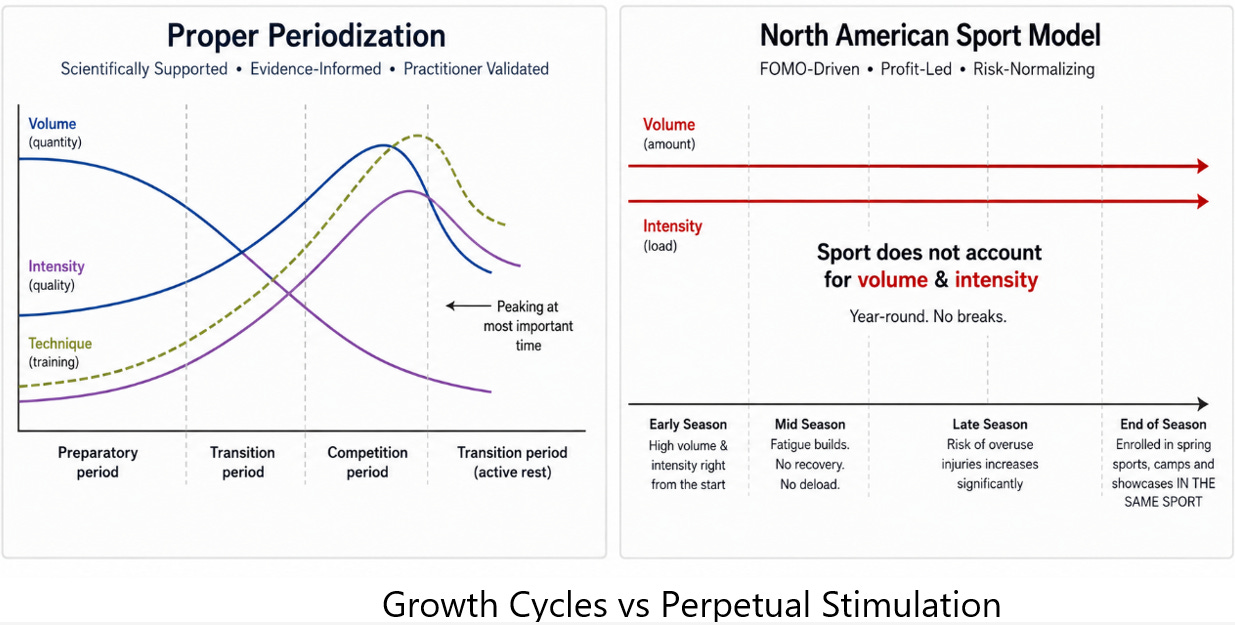
What many youth environments now offer instead is perpetual stimulation. Constant competition, instruction, evaluation and adult control. Children move from organized practice to organized game to organized camp with very little opportunity to simply exist within movement itself.
The irony is that many of the qualities we claim to value most in athletes; creativity, resilience, adaptability, confidence, decision-making and intrinsic motivation are often developed most effectively in the exact environments we have systematically removed: unstructured play, free movement, peer interaction and self-directed exploration. The off-season isn’t a luxury, it is a developmental necessity.
Imagine if clubs committed to protecting two or three months of the year for decompression and regeneration.
Not replacement programming disguised as “optional” training. Not mandatory captain skates or hidden expectation sessions.
Actual recovery, freedom and space. At minimum, this could mean reducing structure and encouraging informal activity. At its best, it could mean intentionally creating environments that reintroduce children to movement without pressure. Equipment left out at parks, open gym access, pickup games, mixed-age activities and community spaces where kids can simply play again.
The exact environments many former elite athletes grew up in before youth sport became increasingly industrialized.
When we listen to sport leadership talk about athlete development, player well-being and long-term sustainability while simultaneously ignoring, or deferring responsibility for the very programming environments they oversee, it’s hard to take them seriously.
When we listen to sport leadership lament about shrinking attraction and retention rates, declining volunteerism, loyalty and the inability to attract coaches, we ask WTF did you think was going to happen? You’ve spent years ruining the very experience people once loved. Who’s lining up to come back for more of that? More Pressure + Less Joy = Less Participation.
The most progressive organizations of the future may not be the ones offering the most programming, they may be the ones disciplined enough to create boundaries around it. The clubs that understand long-term athlete development is not about maximizing short-term volume, but about sustaining lifelong engagement, health and growth. Because ultimately, this conversation is bigger than sport.
We’re shaping young people’s relationship with movement, stress, identity, confidence and self-worth.
We’re teaching them what balance looks like.
We’re influencing whether they view physical activity as a lifelong source of joy or as a system of pressure they cannot wait to escape.
And if we already know that excessive volume, chronic pressure and insufficient recovery introduce meaningful harm to children, then the next look ourselves in the mirror question is:
At what point does knowingly ignoring that reality become negligence?
A great piece of feedback on this article and bigger question:
These points raises broader considerations around the legal and ethical responsibilities of sport leaders to provide developmentally appropriate, evidence-informed environments that prioritize athlete well-being alongside performance outcomes